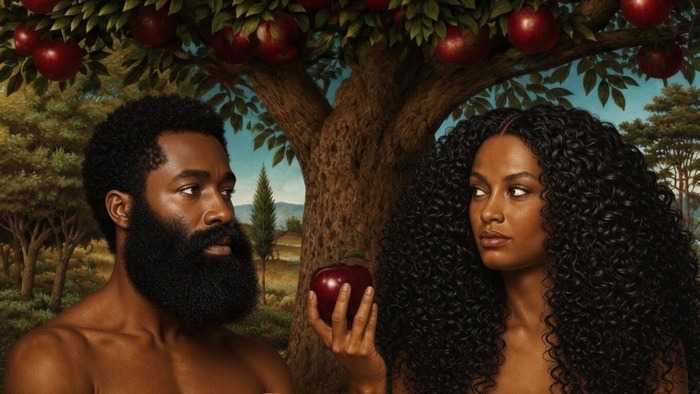

The image of a pale Adam is not an exegetical conclusion. It is a later racial imagination placed onto the beginning of the biblical story. Genesis never presents Adam as European, pale, or white. The text does not describe him with blond hair, thin features, or the complexion found in European religious paintings. Those images came later, after nations began reading themselves back into non-European Scriptures.
The argument that Adam was not pale does not rest on linguistics alone. The Hebrew word-family does matter, but it is only one part of this case. The stronger argument is contextual, logical, and biological. Adam was formed from the ground, named in a word-family connected to earth and ruddy tones, and positioned as the father of all mankind. If Adam stands at the head of humanity, then he must be able to account for the full range, including the strongest and darkest pigmentation expressions found among men.
The pale Adam is not just extremely unlikely; it is incoherent when read against Scripture, inheritance logic, and pigmentation biology. If the first man is the created source from whom all nations descend, then he cannot be reduced to the weakest pigmentation expression and still account for the full strength of human pigmentation. Pale skin does not explain the deepest dark tones without borrowing what it does not naturally possess via genetics. A deeply melanated Adam, however, can logically account for lighter descendants through reduction, recombination, and inheritance.
This is why the conversation cannot be limited to the word “ruddy” as if this is only a dictionary debate. The context of Genesis, the logic of descent, and the biology of melanin all point in the same direction. Adam was not pale. Adam was a dark man with brown-red undertones, carrying the created capacity for the nations that would come from him.
Adam Does Not Mean Pale
The Hebrew text never says Adam was pale. It never says Adam was white. It never gives Adam a European phenotype. The name Adam is connected to the ground from which he was formed, and the ground-language surrounding Adam carries the sense of dark earth, blood, and ruddy brown tones. That does not point toward the absence of melanin. It points toward a man whose name is tied to the substance and color imagery of the earth.
Genesis 2:7 says that the Lord God formed man of the dust of the ground and breathed into his nostrils the breath of life. The man is not introduced as a racial abstraction floating above creation. He is formed from the ground. He is named in relation to the ground. He returns to the ground. This is the biblical context that must govern the discussion.1
The pale Adam comes from later imagination, not from Genesis. When people see Adam painted as a European “Middle Eastern” man, they are not seeing the Hebrew text at all. They are seeing a theological tradition that placed Europe at the beginning of the human story. The same tradition that painted Christ as European “Middle Eastern” also painted Adam as European or pale. That is not exegesis. That is racial projection being superimposed upon the text.
The text gives us Adam from the ground, not Adam from Europe.
Ruddy Is Not Pale
One of the great mistakes in this discussion is the assumption that “ruddy” must mean pink, rosy, or pale with red showing through the visage. That is a European framework reading into the word. In a Hebrew setting, ruddy language does not require pale skin at all. If you dug into the earth, you would not pull back tones of Europe, but tones of Africa. Clay is dark. Soil is dark. Blood language carries dark red tone without suggesting whiteness. A dark brown-red Black man is a better contextual fit than a pale man with sunburned cheeks.
Ruddy does not mean the absence of eumelanin, which moves in black-to-brown expression. It does not mean weak pigmentation. It does not mean European skin with a pink tint. Ruddy describes a brown complexion with visible red undertones, especially when the context is ground, dust, and blood.
This matters because the debate is often framed dishonestly. People act as if the only options are pale red or literal red. But the biblical context gives us a better category: dark brown-red. The red is not the dominant tone. The dark brown is. The red is the undertone, not the foundation. That is why “dark brown-red” is the better expression. It preserves the ruddy language without making Adam look pale or wasted away.
If Adam is formed from the ground and tied to ruddy earth language, the burden of proof is on the person who turns that into pale skin. Nothing in Genesis requires that move.
Melanin and the Power of the Darker Tones
Human pigmentation is shaped by melanin. Eumelanin is the pigment associated with black-to-brown expression. Pheomelanin is associated with red-to-yellow expression. Human complexion is not controlled by one simple switch; it is polygenic. That means multiple inherited factors contribute to the visible result.2
This is important because the strongest pigmentation expressions must be explained and restored to their rightful place. The deepest dark tones among men are not weak expressions, contrary to European conjecture. They are powerful pigmentation outcomes. If Adam is the first man and the father of mankind, then he must be understood as distributing the created capacity for those powerful darker tones.
A pale Adam cannot naturally explain this without complication and imagination. Pale skin represents reduced or limited visible pigmentation. It cannot serve as the best original baseline if it must account for the full power of black-to-brown eumelanin expression. A dark Adam can and does explain lighter descendants through reduction and inheritance. A pale Adam does not explain the stronger pigmentation range without adding what the pale form lacks.
This is not an appeal to macroevolutionary conjecture. This is a creation-based inheritance argument. God made Adam with real created biological capacity. If all nations come from one blood, as Acts 17:26 says, then the first man must carry the range from which later human variation could be expressed. The strongest baseline is not the pale phenotype. The strongest baseline is a deeply melanated man.3
AABB as a Teaching Model
The AABB model should not be treated as the complete genetic map of skin color. Human pigmentation is more complex than two letters. Skin color is polygenic, and the modern genetic picture involves multiple contributing factors. But the AABB model is still useful as a teaching illustration because it shows a simple principle: stronger pigment expression explains darker outcomes, while reduced expression explains lighter outcomes.
In the simplified model, more dominant pigmentation factors produce darker expression. Fewer dominant factors produce lighter expression. The model is not the whole science, but the logic is helpful. It shows why a darker ancestral source can make sense of lighter variation, while a pale ancestral source struggles to explain the highest pigmentation expressions.
This is the point: Adam must be able to explain mankind. He must account for the pale, the brown, and the darkest tones among men. The pale phenotype does not carry the best explanatory power. A dark brown Adam does.
If Adam stood at the head of mankind, he was not the weakest expression of pigmentation. He was the created source carrying the capacity for the full human range. That means he must be understood closer to the deeply melanated man than the pale European image found in religious art.
The Distribution Argument
Paleness is not the universal human baseline. It appears regionally and unevenly. The deepest and most powerful dark tones are not rare accidents in humanity. They are major expressions of human complexion, especially among African and other high-melanin populations. By contrast, very pale skin is concentrated in narrower regional patterns, especially among European populations and some Asian populations.
This matters logically. A trait that appears in a narrow and reduced form should not be assumed to be the original baseline for all humanity. Pale skin looks derivative. Dark skin better explains the range.
Africa is especially important in this discussion because it contains a broad range of dark pigmentation and human diversity. Even when modern scientific sources explain that diversity through evolutionary frameworks, the observation itself is still useful: Africa contains deep and broad pigmentation variation. We do not need to accept macroevolutionary conjecture to recognize the distributional fact.4
The pale Adam argument asks us to believe that the first man looked like the narrowest reduced expression, while the broad and powerful dark expressions came afterward. That is backwards. The more coherent reading is that Adam carried the stronger pigmentation capacity first, and lighter expressions developed later through inheritance patterns of reduction after the spread and separation of peoples.
Dark brown-red skin better fits the original human baseline.
The Hair Question
If Adam was deeply melanated, then the question of hair texture should not be avoided. The European Adam is not only pale; he is usually imagined with European hair and European features. That image is not in Genesis either. It is part of the same false racial projection that turned the first man into Europe’s poster child.
If the argument points toward Adam as dark brown, ruddy, and highly melanated, then it is reasonable to understand him as closer to what older ethnological language called Negro features: dark skin, tightly curled or woolly hair, and strong melanin expression. That conclusion is only controversial for some because European theology trained people to treat whiteness and paleness as normal and Blackness as a deviation.
But Scripture does not teach their beliefs.
The first man does not need to be rescued from Blackness. Blackness was never a curse. Dark skin is never a defect. Woolly hair was never an insult. They were most logically the original created human features God chose to use, and there is no biblical reason to assume Adam lacked them.
The people most offended by a Black Adam are often not defending Genesis. They are defending inherited white imaginary propaganda.
The Pale Adam as Propaganda
The pale Adam is theological propaganda. It does not come from the text. It comes from a world that wanted European-passing people at the center of everything. If Adam is pale, Christ is pale, angels are pale, and biblical righteousness is painted in pale bodies, then Europe becomes the silent owner of all human history.
That is the great deception.
Genesis does not begin with Europe. The first man is not introduced as a European. He is formed from the ground. He is named through earth-toned language. He fathers the human family. If he must explain the range of mankind, then pale skin cannot be his or our starting point.
This is why the pale Adam must be rejected at all costs. You should teach your children to reject those images, so these anachronisms will stop. It is not just bad art. It is bad theology. It is cultural appropriation inserting European identity into the beginning of Scripture and then calling that imagination “biblical tradition.”
I say this plainly: the biblical Adam was not pale.
Conclusion
After reading this, I pray the conclusion is clear: many nations have been lied to about the appearance of Adam. They were given a pale first man because European art and theology placed Europe at the beginning of the human story. But Genesis does not require that fallacy. Logic does not require that deception. Biology does not support that belief.
Adam was not European. Every time he is depicted as pale, the motive behind that image should be questioned and treated with contempt. The text presents a man formed from the ground, tied to dark brown/ruddy earth language, and standing at the head of all mankind. The biological case points toward a man carrying the strongest pigmentation capacity, not the weakest visible expression.
Adam was dark, ruddy, and ancestral. He carried the created potential for the full range of all humanity. The pale European image does not and cannot explain that range. A deeply melanated Adam does very easily.
In plain terms, Adam was the first Black man. He was not the pale European imagination seen in children’s books, religious paintings, and inherited church iconography. He was the father of mankind, formed by God, and the logical source from whom the nations came.
The first man was not pale, sunburned, or blushing when flustered.
He was Black; dark brown-red, and fully human. Shalom.