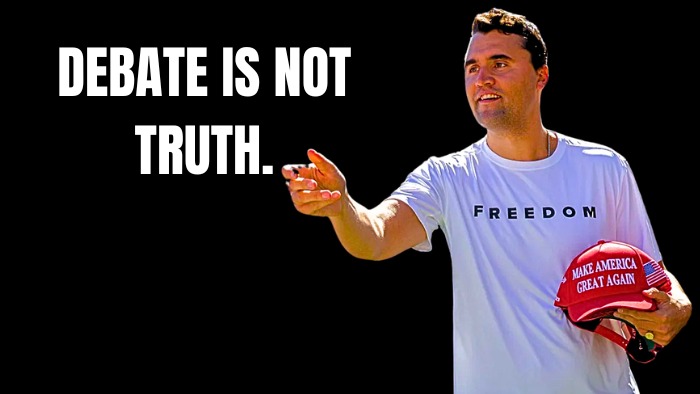

Charlie Kirk is often presented as a strong debater, but speed is not truth, confidence is not logic, and applause is not evidence. Much of his style depends on controlling the frame before the argument even begins. Once the frame is accepted, the conclusion usually follows. That is not careful reasoning. That is rhetorical management.
False Dilemmas
One of the most common fallacies in his arguments is the false dilemma. Complex issues are reduced to two choices: either accept his conservative conclusion or be treated as irrational, anti-American, anti-Christian, or anti-truth. But reality does not work that way. A person can reject liberalism without accepting white conservatism. A person can reject Democrat hypocrisy without bowing to Republican mythology. A person can believe in Scripture without accepting European Christianity.
Straw Man Arguments
Another repeated fallacy is the straw man. Instead of answering the strongest version of an opposing view, he often answers a weaker version that is easier to mock. When Black people talk about systemic racism, the argument gets reframed as victimhood. When people criticize America’s history, the argument gets reframed as hatred of the country. When people challenge white Christian nationalism, the argument gets reframed as hostility toward faith itself. That is not refutation. That is substitution.
Applause Is Not Evidence
He also leans heavily on appeal to popularity. The audience laughs, claps, reacts, and the moment is treated as though the argument has been won. But crowds have cheered lies before. Nations have applauded wickedness before. Scripture does not measure truth by applause. Exodus shows an entire people could panic and follow the wrong image. The prophets show that majorities can be corrupt. Christ himself was rejected by the crowd.
Cherry-Picked Evidence
Another major fallacy is cherry-picking. Select facts are used to protect the preferred conclusion while larger historical realities are ignored. This is especially clear when discussions involve slavery, segregation, policing, education, economics, or Christianity in America. A single statistic is pulled forward while covenant, history, power, law, and material consequence are pushed out of view. That kind of argument is not honest inquiry. It is controlled evidence.
Christianity Is Not Automatically Righteousness
The most dangerous fallacy is the equivocation between Christianity and righteousness. Charlie Kirk often speaks as though defending conservative Christianity is the same as defending biblical truth. But Scripture does not give Europeans the authority to define righteousness for the world. God did not give Israel a shallow political religion. He gave Israelites law, covenant, commandments, judgment, memory, and national responsibility. White Christianity cannot baptize empire and then call itself biblical.
Conclusion
This is why Israelites must learn logic. Not to sound intellectual. Not to win arguments for entertainment. But to avoid being deceived by confident error. A fallacy is not just a mistake in reasoning. In the wrong hands, it becomes a weapon. It trains people to defend power while thinking they are defending truth.
Charlie Kirk’s strength is not that his arguments are unbreakable. His strength is that many people were never taught how to break them.
And that is exactly why we must teach logic, Scripture, and covenant together.