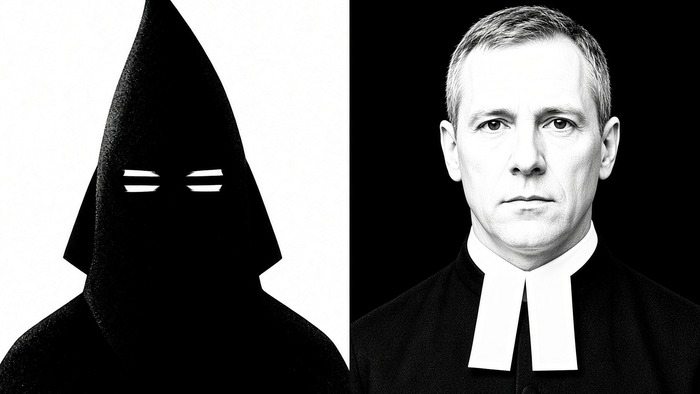

They are not identical definitions. But when Christianity is fused with whiteness, national power, and the myth of a chosen America, the result is the same hierarchy wearing a cross.
Semitic Jew
There is a common defense whenever Christian nationalism is connected to white nationalism: “Christian nationalism is about religion, not race.” At the level of dictionary definitions, that distinction is real. White nationalism seeks a nation organized around white identity and political power. Christian nationalism seeks to fuse a particular version of Christianity with American identity, law, and public life.
But political movements must be judged by more than the labels they choose. We must ask whom they define as the rightful owners of the nation, whose history they protect, whose suffering they minimize, and whose power they seek to restore.
When those questions are applied to the dominant American form of Christian nationalism, the distance between the two ideologies begins to collapse. White nationalism declares that the nation belongs primarily to white people. Christian nationalism gives that ownership claim divine authorization. One supplies the racial hierarchy; the other places a cross over it.
That does not mean every Christian, every conservative, or every person who uses patriotic religious language is secretly a white nationalist. It means that the dominant political form of white Christian nationalism performs the same work: it protects a national identity historically built around white power and presents that identity as God’s intended order.
The distinction is real—but it is not the end of the argument
A 2026 study published in Nature explicitly distinguishes white nationalism from Christian nationalism. The researchers define Christian nationalism as an ideology seeking to fuse Christianity with American civic life, while white nationalism concerns support for a nation centered on white identity and interests. That distinction matters because careless definitions make serious criticism easier to dismiss.
Yet two concepts can remain analytically distinct while operating together politically. A key may be different from a lock, but the distinction does not tell us what happens when the key turns it.
Christian nationalism does not need to announce “white supremacy” in order to preserve it. It only needs to identify an older, whiter, Anglo-Protestant America as the authentic nation; treat demographic and cultural change as decline; describe efforts to correct racial inequality as attacks on “real Americans”; and present the restoration of that social order as obedience to God.
The racial message can therefore remain implicit. “Take America back” raises an unavoidable question: back from whom, and back to what?
Christianity becomes a credential for belonging
Modern Christian nationalism is not simply the belief that a Christian should allow Scripture to inform personal conduct. It is a political story about who counts as a true American.
Peer-reviewed research describes Christian nationalism as a set of beliefs that idealizes America’s supposed special relationship with Christianity and seeks to institutionalize Christian dominance. But the “Christianity” most visible in the movement is not a neutral summary of all believers. It is commonly tied to a native-born, white, conservative, Anglo-Protestant identity.
This is why the word “Christian” often functions as more than a confession of faith. It becomes a cultural boundary. It signals whose customs are normal, whose account of history is patriotic, whose anger is legitimate, and whose authority should govern everyone else.
In that structure, Christianity is not merely being practiced. It is being used as proof of national ownership.
The historical pattern is not difficult to recognize
America has repeatedly joined white hierarchy to religious legitimacy.
Enslavement was defended from pulpits and through selective readings of Scripture. Segregationists appealed to divine order. The second Ku Klux Klan presented itself not only as white and nativist but also as Protestant and “100 percent American.” National Park Service historical documentation describes the 1920s Klan as a white, Protestant, male-dominated order committed to religious fundamentalism, conservative social control, white supremacy, and defense of the flag.
Those elements were not randomly collected. Whiteness defined the preferred people. Protestant identity supplied moral legitimacy. Nationalism gave the project political territory. Patriarchy determined social authority. The flag transformed group power into patriotism.
This is the same architecture that appears whenever a movement claims that America must be “restored” to a supposedly Christian identity while resisting an honest account of slavery, segregation, dispossession, and continuing racial inequality.
The symbols can change. The structure remains recognizable.
The modern evidence shows racial hierarchy beneath the religious language
Recent research does not prove that every Christian nationalist consciously embraces white nationalism. It does show that, among white Americans, Christian-nationalist belief is repeatedly associated with attitudes that protect white status and minimize anti-Black injustice.
A 2025 Social Forces study found that Christian nationalism increased white racial solidarity while failing to produce the same pattern among nonwhite Americans. The authors concluded that Christian nationalism among white Americans can amplify both white in-group solidarity and hostility toward racial outsiders in the service of white supremacy.
Research published in Public Opinion Quarterly likewise found that race changes how Christian-nationalist beliefs operate. Among white Americans, those beliefs were generally unrelated or negatively related to progressive identity. Among Black and Hispanic Americans, some associations moved in the opposite direction. This matters because it prevents a lazy conclusion that any Black person who affirms Christian language about the nation is politically identical to a white nationalist.
The argument must therefore be precise: Christian nationalism is not automatically white nationalism in every individual mind. But its dominant white American expression is historically formed through white identity and repeatedly advances the same boundaries of belonging.
Public Religion Research Institute data makes the overlap more visible. In its national survey, majorities of Christian-nationalist adherents and sympathizers rejected the claim that white supremacy remains a major problem. Among white adherents, 66 percent rejected that claim. Eighty-three percent of white adherents rejected the idea that generations of slavery and discrimination continue to make economic advancement more difficult for many Black Americans. Eighty-five percent said discrimination against white Americans is as serious as discrimination against Black Americans and other minorities.
Those findings do not establish the private motives of every respondent. They do reveal the political function of the ideology: it sacralizes the nation while denying or minimizing the racial order that shaped it.
Christian nationalism borrows Israelite identity without Israelite covenant responsibility and suffering
The greatest biblical problem with American Christian nationalism is not merely that it has historically been racist and can become covertly racist. Rather, its foundational claim is unsupported by Scripture.
The Bible identifies the Israelites—not Americans—as the nation selected by God for covenantal reasons. Moses told the Israelites, “the LORD thy God hath chosen thee to be a special people unto himself” (Deuteronomy 7:6).
The commandments and judgments were given to Jacob, who became Israel, and not to the other nations (Psalm 147:19–20). Paul, an Israelite, likewise wrote that to the Israelites belonged “the adoption, and the glory, and the covenants, and the giving of the law” (Romans 9:4).
Scripture never transfers that national covenant to the United States. America is not the biblical Israel. Its flag is not a covenant sign. Its Constitution is not the law delivered at Sinai. Its military victories do not prove divine election. Its economic power does not establish righteousness.
Christian nationalism nevertheless borrows the language of a chosen people, a promised land, divine favor, national apostasy, and sacred restoration—then applies those ideas to an American order historically governed by Europeans and their descendants.
Once America is falsely cast as God’s chosen nation, preserving the historic ruling population can be portrayed as preserving God’s design. Demographic change becomes “replacement.” Equality becomes persecution. Teaching Black history becomes hatred of America. Resistance to white control becomes rebellion against God.
White nationalism identifies the preferred race. Christian nationalism manufactures the divine permission slip.
Scripture does not excuse partiality because it is patriotic
The biblical test is not how frequently a movement says “God,” displays crosses, or quotes isolated verses. The test is whether its judgment agrees with the commandments of God.
“God is no respecter of persons” (Acts 10:34). James condemns partiality and describes it as sin (James 2:1–9). Isaiah denounces those who “decree unrighteous decrees” and deprive the poor of justice (Isaiah 10:1–2). Amos rejects religious performance divorced from judgment and righteousness (Amos 5:21–24).
A political movement does not become biblical by placing Christian vocabulary over favoritism, false history, exploitation, or unjust power. If it protects racial hierarchy, excuses oppression, and treats national dominance as evidence of divine approval, its religious language increases its hypocrisy; it does not cleanse it.
Not all forms of Christianity—and not all Christians
This critique is not an argument that people who identify as Christian are white nationalists. Many Black believers—who are, in fact, ethnic descendants of Abraham, Isaac, and Jacob—used Scripture to denounce enslavement, segregation, and colonial theology. Abolitionists also used Scripture to correct white American behavior during colonial times. The same Bible slaveholders attempted to distort became a source of judgment and condemnation against them.
The conflict is therefore not “Christianity versus secularism.” It is truth versus political religion. It is the commandments of God versus a national mythology that uses God to protect inherited power.
Nor is the argument that every supporter understands the full racial history of the movement. Ideologies often reproduce a hierarchy without every participant consciously accepting its most explicit form. A person can defend the effects of a system while rejecting the name scholars use to describe it.
That is why intentions alone cannot settle the question. We must examine the story being told, the power being protected, and the people being excluded.
Two banners over the same hierarchy
White nationalism says America belongs to white people.
Christian nationalism says the America built under white rule possesses a special Christian identity that must be restored and defended.
The first states the racial claim openly. The second often translates it into the language of faith, heritage, morality, and divine order. They are not identical in every definition, organization, or individual supporter. But in their dominant American political form, they converge on the same project: preserving a hierarchy in which white Christian culture remains the standard of authentic American belonging.
The question is not whether the movement can find a Bible verse for its rhetoric. The question is whether Scripture authorizes America to claim Israel’s covenant, excuse partiality, conceal oppression, or call inherited dominance righteousness.
It does not.
White nationalism places whiteness above the nation. Christian nationalism places the nation beneath a cross. When the nation being sanctified is the same racial hierarchy, the difference is largely one of presentation.