
Language drifts over time. Words collect new meanings, lose old meanings, and sometimes become so familiar in English that readers forget to ask what the Bible actually said in Hebrew and Greek. That is the danger with the word Gentile. If we take the modern English category and force it backward into Moses, David, the prophets, Christ, and the apostles, we may end up reading later assumptions into earlier texts. Faithful interpretation begins by asking what the biblical authors meant in their own language, covenant setting, and historical world.1
What Does “Gentile” Mean in Scripture?
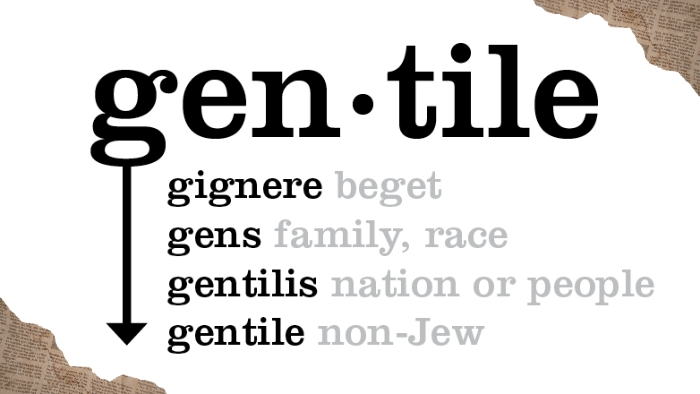
The English word Gentile often hides a range of underlying terms. In the Hebrew Scriptures, the major word is goy or goyim, meaning nation or nations. In the Greek New Testament, terms such as ethnos, ethnē, and genos can speak of nations, peoples, kindred, stock, family, or ethnic descent depending on the passage. That means the reader cannot define the word by habit alone. The context must govern the meaning.
“Beget” — Kin by Descent
The Greek family root gen- points to begetting, kind, stock, family, or descent. Words such as genos can identify a people according to lineage or kinship. Peter speaks of believers as a chosen genos, and Mark describes the Syrophoenician woman according to her ethnic stock or nation.2 In these settings, the idea is not merely “non-Jew.” It is peoplehood, kind, lineage, or family identity.
“Family / Ethnicity” — A People as a House or Clan
Scripture often treats a people as an extended household. Jacob is promised “a nation and a company of nations,” and Israel is called a holy nation.3 These terms show that peoplehood in Scripture is not limited to modern political borders. It includes descent, covenant, household, land, worship, and shared identity. The same semantic range appears in the New Testament when ethnos and genos are used of Israel and other peoples.
“Nation / People” — Political or Cultural Bodies
The Tanakh uses goy and goyim broadly. Sometimes the word refers to other nations. Sometimes it refers to Israel herself. Israel can be called a wise and understanding nation, and the prophets can address Israel with the same category of national language used elsewhere for the nations.4 Likewise, the New Testament’s ethnos can refer to non-Israelite nations or to Israel depending on the sentence. The term is flexible; the context decides.
“Non-Jew” — Someone Outside Judea’s Polity in Certain Contexts
There are also contexts where “Gentile” functions socially or politically, especially in relation to Judea, Jews, Greeks, and diaspora settings. Regions like “Galilee of the Gentiles” included Israelites living among other peoples. John 7 speaks of the dispersed among the Gentiles and raises the question of teaching the Greeks.5 That passage forces the reader to slow down: Israelites could be living among the nations, speaking Greek, and being described through the geography and culture of dispersion.
Israelites Called “Gentiles” in Various Contexts
Israel can be called a nation. Israel can be called a company of nations. Israelites can be scattered among the nations. Israelites can live under foreign rule, speak foreign languages, and be described according to the land or polity around them. This is why a simplistic definition of “Gentile” as “everyone who is not Israel” can create interpretive problems. The Bible itself uses the underlying words more carefully than that.
In the Apocrypha, the contrast between Jews and Gentiles often reflects political, cultural, and covenant pressure under foreign domination. Under Hellenistic power, some Israelites were pressured to adopt foreign customs, forsake the law, and merge into the surrounding nations.6 In those settings, “Gentile” can mark a boundary of law, worship, culture, and political allegiance, not merely a modern biological category.
Beware the Anachronous Fallacy
An anachronism happens when we read a later meaning back into an earlier text. This is one of the most common mistakes in biblical interpretation. When modern readers load “Gentile” with a fixed modern sense, they can flatten the text and erase the way Scripture actually uses goy, ethnos, and genos across different settings.7
Modern Examples of Anachronism
One error is treating ancient nations as if they were modern race boxes. Another is separating religion from nationhood as though Israel’s covenant identity were merely a private belief system. A third is English gloss absolutism, where a reader assumes the English word “Gentile” always settles the meaning, even when the Hebrew or Greek term can refer to Israel, nations, families, or peoples depending on context.
Biblical Harmony: Israel and the Nations
The promise to Abraham was that families and nations would be blessed through him. The prophets speak of Israel’s light reaching the nations. The New Testament proclaims the ingathering of the nations without erasing Israel’s identity, covenant priority, or prophetic role.8 A careful reading does not flatten Israel into the nations, and it does not deny that the nations appear in the plan of God. It lets every term speak according to context.
Conclusion
The term Gentile has contextual meaning. Sometimes it speaks of nations generally. Sometimes it speaks of non-Israelite peoples. Sometimes the same underlying words can describe Israel as a nation, a people, or a scattered body among other nations. The faithful reader must avoid anachronism and let Scripture define its own categories. “To the Jew first, and also to the Gentile” should not be forced into a modern racial or religious framework before the biblical language is allowed to speak.