America has a habit of calling the people who expose its history divisive. But who created the false story in the first place?
The United Daughters of the Confederacy helped promote a version of history that defended the Confederacy and its racial order. Its leaders pushed schools to reject books that identified slavery as the South’s cause, and the organization endorsed a book portraying the Ku Klux Klan as heroic. That was intentional.
The same kind of rewriting appears when people claim Europeans brought culture to American peoples. Those nations already had languages, governments, agriculture, trade, and roads.
You cannot plant your flag where people already live and claim their history began when you arrived.
They wrote instructions for changing the story
Mildred Lewis Rutherford, a former historian-general of the United Daughters of the Confederacy, prepared A Measuring Rod to Test Text Books, and Reference Books in Schools, Colleges and Libraries as part of a textbook campaign organized in 1919. Her instructions were clear:
“Reject a book that says the South fought to hold her slaves.”
She also instructed readers to reject books describing Southern slaveholders as cruel and unjust. The accompanying committee statement asked libraries to mark books that failed its standards “Unjust to the South.” This was an organized attempt to control which accounts reached classrooms and library shelves.1
Now compare that instruction with Mississippi’s own explanation for leaving the Union in 1861:
“Our position is thoroughly identified with the institution of slavery—the greatest material interest of the world.”
Mississippi’s secessionists identified slavery as central to their cause.2 Rutherford later told educators to reject that explanation. The contradiction is right there in the documents.
From our biblical standpoint, stealing people and selling them calls for condemnation, not a respectable new label (Exodus 21:16; 1 Timothy 1:10). Calling it an institution does not erase what was done to the people.
Turning the Klan into heroes
The effort went beyond defending the Confederacy.
Laura Martin Rose, a leader in the Mississippi division of the UDC, wrote The Ku Klux Klan; or Invisible Empire, published in 1914. The UDC endorsed the book at its 1913 national convention and advocated its use in Southern schools.
Rose portrayed the Klan as defending white society and restoring order. Her account shifted responsibility for Reconstruction violence toward Black people and their allies, presenting white violence as a necessary response to a supposed threat.3
That framing teaches children who to admire before they have examined what those people did. It turns the perpetrators into protectors and makes the people they attacked responsible for their own mistreatment.
Isaiah 5:20 condemns that moral reversal:
“Woe unto them that call evil good, and good evil; that put darkness for light, and light for darkness…”
Painting racial terrorism as a good thing does not change its wicked nature. It changes how the audience is conditioned to view it.
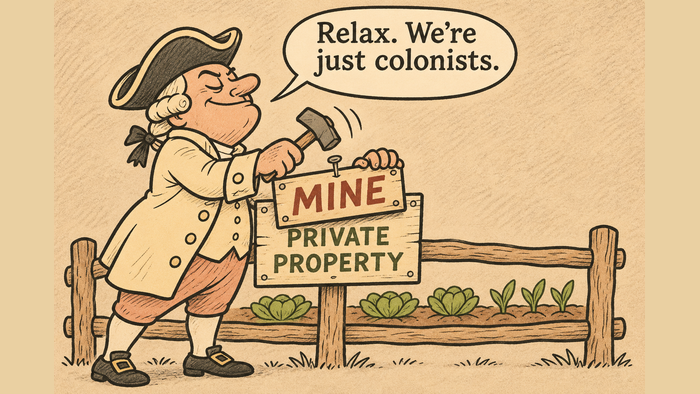
“We were colonists” does not establish ownership
Imagine a foreign group arriving in your front yard tomorrow. They put up buildings, establish their own rules, and announce that your property now belongs to their government.
You ask who gave them permission.
Their answer: “We are colonists.”
That tells you what they are doing. It does not explain why they have the right to do it.
If they claim to respect property while taking yours without permission, their conduct contradicts their stated principle. If they say their government authorized them, the question remains: what gave that government ownership of your home? Does that government own the Earth?
Calling the settlement a colony does not answer either question.
The same standard applies to nations. Colonial status describes a political relationship. It does not, by itself, establish a legitimate claim to somebody else’s land.
“Thou shalt not steal.”
Micah addresses the seizure of land directly:
“And they covet fields, and take them by violence; and houses, and take them away…”
The verse continues by condemning oppression of a man, his household, and his inheritance. Putting a flag over the property does not settle whether it was stolen.
The people already had societies
The claim that Europeans brought culture to North America depends on minimizing what existed before their arrival.
At Chaco Canyon, ancestral Pueblo communities engineered roads, rock-cut stairways, and masonry ramps. The purposes of particular roads remain subjects of archaeological discussion, but their existence and construction are established.4
Indigenous nations had distinct languages, governing traditions, agricultural knowledge, and extensive trade networks. Some of their routes later became roads and highways used by Euro-Americans. These were different peoples with different societies—not one population waiting for Europeans to introduce culture.5
The erasure still appears in modern political speeches. In April 2021, Rick Santorum said:
“We birthed a nation from nothing. I mean, there was nothing here.”
He immediately acknowledged Native Americans, then minimized their contribution to American culture.6 That qualification does not resolve the problem: the societies already there become a footnote to the story of European achievement.
A place does not become empty because its inhabitants organize life differently from you.
They recognized boundaries, then violated them
Treaties make the ownership question harder to evade. They record agreements with peoples whose territory and authority the United States was negotiating over.
The 1868 Fort Laramie Treaty reserved land, including the Black Hills, for the Sioux peoples’ use and occupation. In 1874, George Armstrong Custer led an expedition into the Black Hills despite that agreement. The United States confiscated the Black Hills in 1877.7
These were actions of the independent United States, decades after British colonial rule ended. “We were just a colony” cannot explain them away.
Scripture also rejects the idea that agreements with foreign peoples are disposable. In Ezekiel 17:13–19, God condemns Zedekiah for breaking his sworn agreement with Babylon. The foreign identity of the other ruler did not erase the obligation.
An agreement does not stop mattering because keeping it becomes inconvenient—or because the other party can no longer force you to honor it.
Destroying the buffalo weakened the people
Expansion also involved destroying the resources that supported Indigenous independence.
Commercial hunters slaughtered buffalo for their hides. Military support for that destruction served the additional purpose of weakening Plains nations by removing a major source of food and other necessities. Commercial demand, settlement, railroads, and military objectives helped devastate the herds.8
We do not need to pretend every buffalo was killed under one military order to recognize the relationship between that destruction and conquest.
Destroying a people’s means of survival, then treating their resulting dependency as proof that they needed your supervision, reverses responsibility.
Habakkuk 2:8 condemns plunder, bloodshed, and violence against lands and their inhabitants. Verse 12 declares:
“Woe to him that buildeth a town with blood, and stablisheth a city by iniquity!”
The passage addresses Babylon. Its condemnation gives us a standard for examining empire, not permission to excuse comparable conduct under an American flag.
Expanding the border does not justify the bloodshed
Amos 1:13 makes the connection explicit. God condemns Ammon for atrocities against pregnant women in Gilead committed “that they might enlarge their border.”
The territorial objective did not excuse the atrocity. It was part of the indictment.
A larger country is not proof of a righteous cause. Neither military victory nor economic growth establishes that God approved the methods used to obtain them.
They put conquest where God’s authority belonged
Deuteronomy 32:8 describes the Most High dividing the nations’ inheritance and establishing their boundaries “according to the number of the children of Israel” (KJV). The next verse identifies Jacob as the Lord’s allotted inheritance.
In this account, the ordering of nations begins with God’s authority. It does not begin with whichever empire possesses the strongest army.
Deuteronomy 2 makes that distinction concrete. God prohibited Israel from seizing the territories he had assigned to Esau, Moab, and Ammon (Deuteronomy 2:5, 9, 19). Even Israel’s election did not make every neighboring territory Israel’s property.
These passages do not provide a map of modern borders. They do establish that wanting land and having the power to take it are not the same as receiving authority from God.
The inversion comes when conquerors treat their own appetite as divine permission: we wanted it, we conquered it, therefore God intended us to have it.
That conclusion does not follow.
The Lost Cause worked through a similar reversal. Defenders selected the reputation they wanted to preserve, then demanded a history that protected it.
Man stealing became a good thing. The Klan became righteous protectors. Dispossession became civilization.
We do not have to accept their labels. We can read their instructions, examine their agreements, identify what they took, and apply the same standard to the people who claimed to act in God’s name.